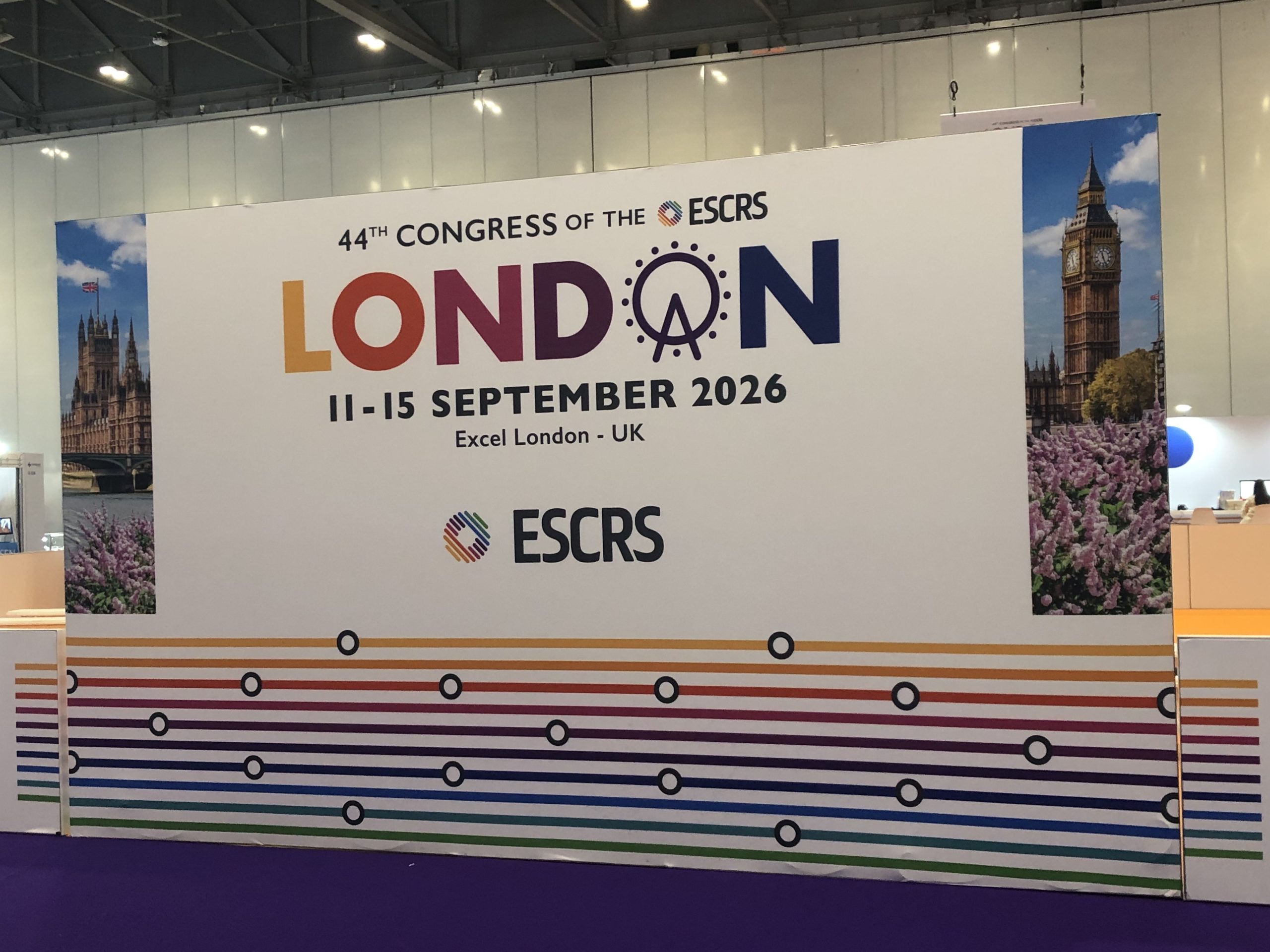

Mr Simcock attended the European Society of Cataract and Refractive Surgeons (ESCRS) meeting, held at ExCeL London. With more than 17,000 attendees from 130 countries, it was a truly international event.
One of the highlights was a review of the scientific literature demonstrating an association between air pollution and the development of cataracts and glaucoma. This provides yet another reason to improve air quality.
Artificial intelligence (AI) was inevitably high on the agenda. Although this technology relies on substantial computing power and large data centre, it has the potential to improve quality of life and access to healthcare, particularly for people living in developing countries.
Smartphone technology can now capture images of the eye and transmit them for remote assessment, helping to diagnose a range of eye conditions. Of particular relevance to this meeting was the use of this technology to identify cataracts in remote communities in southern India. Community health workers required just three hours of training to learn how to capture the images and send them to a specialist reading centre for assessment.
The same technology can also be used to capture images of the retina, with the potential to improve screening for diabetic eye disease. This is particularly important given the increasing global prevalence of diabetes.
Of particular relevance to my own practice was the confirmation of an approach I have favoured for some time: reducing dependence on glasses following cataract surgery while minimising unwanted visual side effects.
Multifocal intraocular lenses can provide good vision at both distance and near, reducing the need for glasses. However, they can also produce unwanted visual phenomena, particularly glare and halos, and may compromise visual quality in low-light conditions. These effects can be especially noticeable with diffractive lens designs, which use a series of fine optical rings on the lens surface to distribute light between different focal points.
Although many patients are very happy with multifocal lenses, my preferred approach is often what is known as mini-monovision or blended vision.
My current preferred lens is the TECNIS Eyhance, an enhanced monofocal lens, sometimes referred to as a monofocal plus lens. It is designed to provide good distance vision alongside improved intermediate vision, which is particularly useful for activities such as using a computer screen or viewing a car dashboard.
When both eyes require cataract surgery, this approach offers an opportunity to tailor the optical outcome of each eye. One eye can be corrected primarily for distance vision and improved mid-distance vision, while the other eye is left with a very mild degree of short-sightedness (myopia), typically around half to three-quarters of a dioptre.
This small difference between the eyes allows them to work well together while potentially providing a greater degree of near vision without glasses. Reading glasses may still be needed, particularly in poor lighting or when reading very small print, but dependence on glasses can be reduced.
An important advantage of this approach is that it avoids many of the unwanted visual phenomena associated with multifocal lenses, particularly glare and halos.
This has been my preferred approach for some time, and it was encouraging to hear many respected international speakers advocating similar techniques.