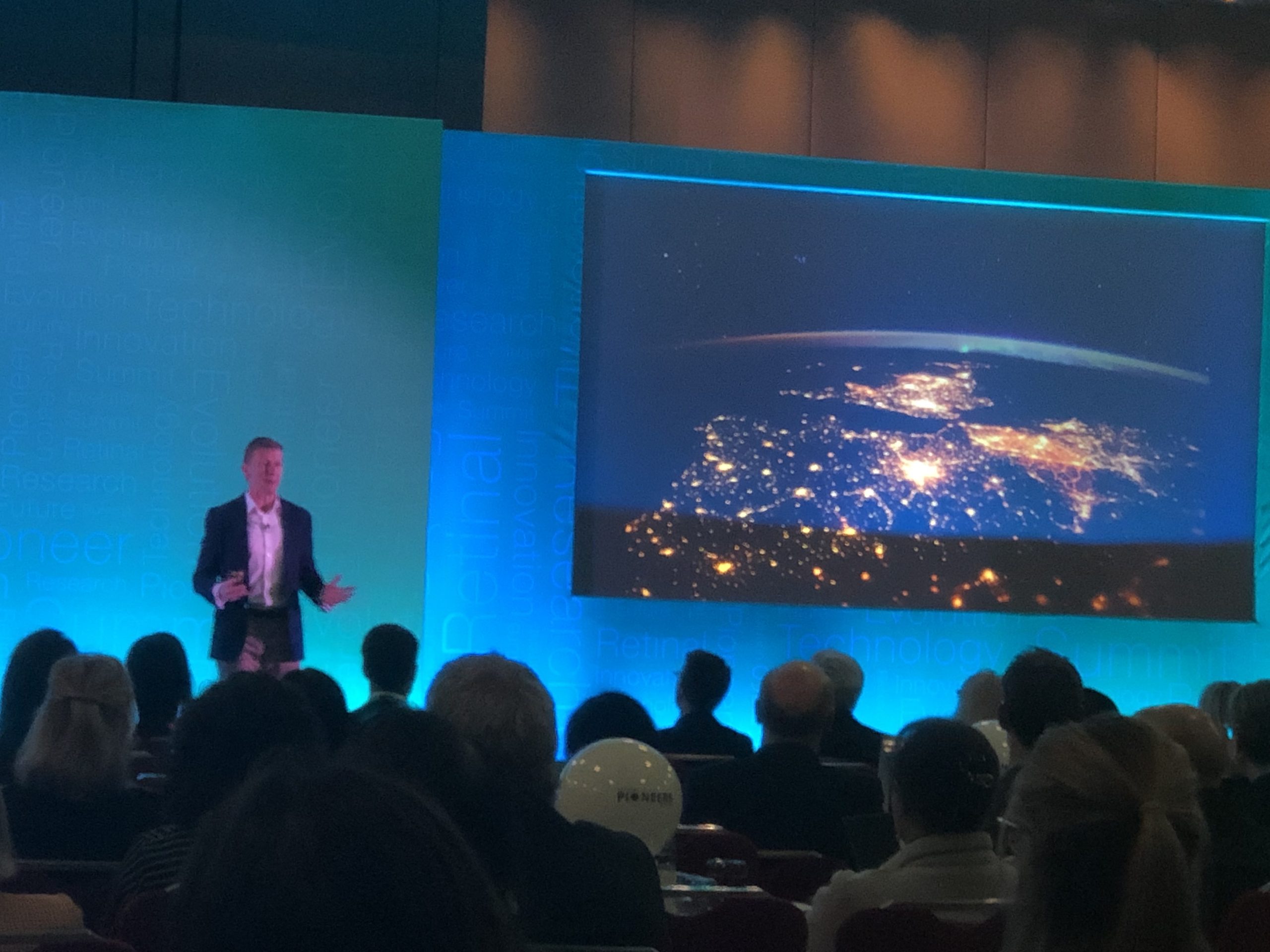

Mr Simcock attended the annual Retinal Pioneers Summit in London, sponsored by Roche, the pharmaceutical company that manufactures Eylea, an anti-VEGF treatment used for several retinal conditions.
A key topic at the meeting was Eylea HD, a higher-dose formulation of aflibercept. While standard Eylea contains 2 mg of aflibercept, the HD formulation contains 8 mg. The meeting highlighted the expanding role of this treatment, which is now licensed for three major retinal conditions: diabetic macular oedema, wet age-related macular degeneration and retinal vein occlusion.
Eylea HD may be particularly beneficial for patients who have responded suboptimally to other anti-VEGF treatments or who require frequent injections to keep their condition under control. In selected cases, the higher-dose formulation may improve treatment response and allow longer intervals between injections, potentially reducing the burden of ongoing treatment.
The guest speaker was Dr Tim Peake, the first British European Space Agency astronaut to visit the International Space Station and the first British astronaut to undertake a spacewalk. He described the extraordinary challenges of his mission, including a spacewalk to repair an electrical fault. The operation had to be curtailed when water accumulated inside the helmet of a fellow astronaut, illustrating the potentially life-threatening nature of working in space.
Tim also discussed the gruelling preparation required for spaceflight, including spending seven days in a cave alongside fellow trainee astronauts. He emphasised the importance of thorough briefings before a mission and debriefings afterwards, principles that are equally relevant to surgical practice. Ensuring that the entire theatre team understands the planned procedures, the correct intra-ocular lens power and any individual patient requirements is essential for safety. Equally important is reviewing each operating list afterwards, identifying what went well and where improvements could be made.
Tim also described experiments conducted aboard the International Space Station to investigate how the human body responds to microgravity. These included NASA’s ocular health research, which involved repeated measurements of his eyes to assess how the absence of normal gravity affects fluid distribution within the eye and influences ocular structures. Such research helps scientists better understand the effects of spaceflight on vision and in particular a condition called spaceflight-associated near-ocular syndrome (SANS) which can result in swelling of the beginning of the optic nerve at the back of the eye. These changes fortunately are mild and do not affect every astronaut but may be of greater relevance when more prolonged space flights are planned such as trips to Mars.
A fascinating talk and a very brave man